
2D as-built drawing services
Engineering-ready 2D drawings created from verified existing-condition data.

Why 2D drawings remain essential
3D models are powerful, but 2D drawings remain the primary reference on job sites and in design offices. They are faster to interpret, easier to mark up, and universally understood across trades—making them essential for coordination, construction, and documentation.
When 2D drawings are the right tool
2D drawings are most effective when speed, clarity, and simplicity matter. Whether planning a retrofit, coordinating trades, or documenting existing conditions for compliance, as-built drawings provide a clear, reliable reference without unnecessary complexity.
Retrofit and renovation planning
Mechanical, electrical, and piping coordination
Facility compliance and regulatory documentation
2D as-built drawings you can rely on
Each project produces clear, accurate 2D drawings derived from field-verified reality capture data—ready for construction, compliance, and long-term facility use.
As-built plan drawings
Accurate floor plans generated from laser-scanned point cloud data, reflecting true existing conditions rather than assumed layouts.
Elevations and sections
Detailed elevation and section views extracted directly from scan data, providing reliable vertical and spatial relationships for design, retrofit, and coordination work.
System-specific drawings
Discipline-focused drawings for mechanical, electrical, piping, or architectural elements—tailored to project scope and coordination needs.
Dimensioned and annotated layouts
Drawings include critical dimensions, reference points, and annotations required for construction, fabrication planning, and field verification.
Standard CAD file formats
Delivered in industry-standard formats such as DWG and DXF, structured for easy integration into existing CAD workflows.
Verified accuracy and QA review
All drawings are reviewed against the registered point cloud and project requirements to confirm alignment, completeness, and consistency before delivery.
From field data to usable drawings—in three phases
We follow a disciplined workflow to ensure 2D drawings accurately reflect real-world conditions. Each phase is designed to eliminate assumptions, reduce rework, and deliver drawings your team can trust.
Scope and drawing definition
We begin by confirming drawing intent, required disciplines, and level of detail. This includes identifying which areas, systems, and views are needed and aligning on standards for dimensioning, annotation, and file structure.
Data extraction and drafting
Using registered laser scan data as the source of truth, our team extracts geometry and creates 2D plans, sections, elevations, and system drawings directly from verified existing conditions.
Review, validation, and delivery
All drawings are reviewed against the point cloud and project requirements to confirm alignment, completeness, and accuracy. Final files are organized, labeled, and delivered in standard CAD formats ready for immediate use.
Outcomes that support real-world execution
Clear, accurate 2D drawings reduce friction across planning, construction, compliance, and ongoing facility operations.
Faster field communication
2D drawings provide a clear, familiar reference for crews and stakeholders—making them easier to review, mark up, and use on site without specialized software.
Reduced rework and assumptions
Drawings derived from verified scan data reflect actual conditions, minimizing errors caused by outdated records, manual redlines, or assumed dimensions.
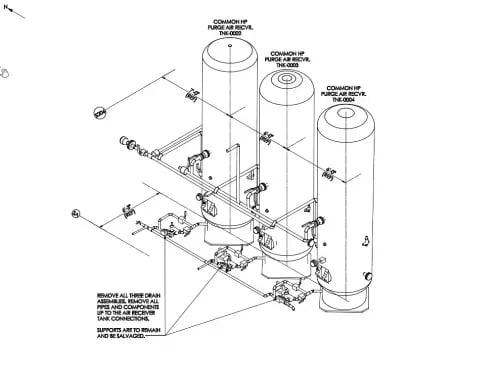
Simpler coordination across trades
Plans, sections, and elevations give each trade the views they need to coordinate work efficiently—without the overhead of full 3D model navigation.
Reliable long-term documentation
As-built drawings remain a practical, accessible record after project close—supporting compliance, maintenance, renovations, and future modifications.
Start with accurate data you can trust
Talk with our team about your facility, scope, and objectives to determine the right capture, modeling, and analysis approach.