
BIM coordination that keeps two things from occupying the same space
AsBuilt 3D runs BIM coordination for MEP trades, general contractors and owners — resolving every clash in the federated model so it never becomes a change order, a stalled crew or a surprise in the field. For trades without a VDC department, we are that department.

Every clash resolved in the model is one that never stops a crew
BIM coordination does one thing: it makes sure no two objects end up occupying the same space. Get that right and installation runs to the schedule you planned — pipe goes where the model says, trades hit their windows, and nobody stands around waiting on a change order or on another trade who hit a problem. Get it wrong and you pay for it in field labor, rework and time nobody budgeted.
BIM and VDC capability without standing up a department
Plenty of trades lose work simply because a job requires BIM coordination and they have no VDC team to put on it. We become that team — which means you can bid the larger, BIM-mandated jobs. General contractors use us the same way: somewhere to send trades who need real coordination support rather than a box ticked.
Bid BIM-mandated work without hiring a VDC team
A coordination partner GCs can point their trades to
U.S.-based BIM and VDC professionals on every call
We work directly with your BIM manager and the other trades
Deliverables from BIM coordination
What coordination actually produces — starting with the only output that matters on site: a federated model where nothing collides.
A clash-free federated model
Every trade merged into one coordinated model, with each conflict between disciplines found and resolved before anything is fabricated or installed.
Clash detection and coordination reports
Documented clashes and interferences, each located, categorised by discipline pair and tracked to closure — not handed over as a raw clash count.
Rack, equipment and clearance coordination
Pipe racks, cable tray runs, duct mains and equipment arrangements coordinated against measured structure, with clearances and access routes validated. The congested zones where most retrofit conflicts originate.
Issue tracking and coordination summaries
A clear record of every conflict identified, the decision taken and the outcome — the audit trail that keeps trades, owner and engineer aligned on what was agreed.
Scan-based coordination context
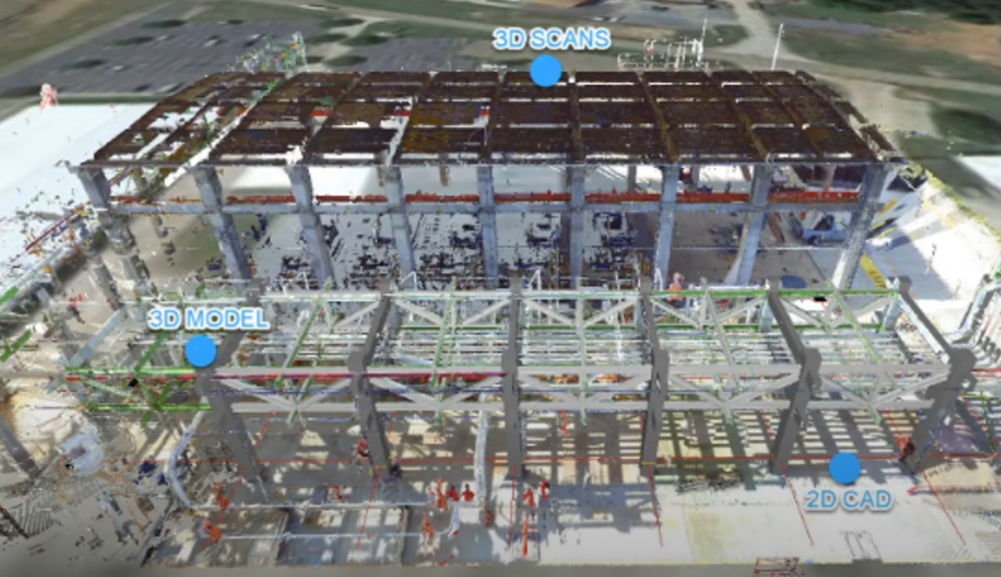
Coordination models anchored to retained point cloud data, captured at ±2 mm at 10–15 m. If a dimension is questioned, it can be re-measured against the original scan rather than argued about.
Industry-standard file formats
Models and reports in the formats your BIM and design tools already read. Tell us the target platform and version at scoping.
The coordination workflow, start to finish
We scope the work, model it, and then sit in the coordination meetings with your BIM manager and the other trades until the federated model is clash free.
Define the coordination scope
We agree the trades in play, the clash matrix, the meeting cadence and what resolved means — inside whatever process the GC already runs. Quotes come back within 24–48 hours as fixed-fee proposals.
Model and federate
Your scope is modeled and merged with the other trades into a single federated model. Where the building already exists, that model is built on measured conditions rather than on a design set that may no longer match.
Coordinate until it is clash free
Our own people are on the calls — U.S.-based BIM and VDC professionals who have run coordination themselves — working each conflict with your BIM manager and the other trades until the model is clean and signed off.
Fewer surprises in the field. Fewer change orders.
What clash-free coordination is worth once crews are on site.
Fewer change orders
A conflict resolved in the model is a revision. The same conflict found on site is a change order. Clients typically see a 20–40% reduction in RFIs and change orders on scan-based design work.
Installation that goes to plan
What gets installed matches what was coordinated, so trades work their planned sequence instead of improvising around whatever they find.
Crews working, not waiting
Nobody stands idle while a clash is argued out or another trade backs out of your space. Schedules hold because the conflicts were settled before mobilisation.
Work you can bid
BIM-mandated projects stop being off-limits when the coordination capability is already in place. Clients typically see a 5–10x return on the investment.
Start with accurate data you can trust
Talk with our team about your facility, scope, and objectives to determine the right capture, modeling, and analysis approach.