Reverse engineering from real-world geometry
AsBuilt 3D uses high-resolution scanning and precision modeling to reverse engineer parts, assemblies, and systems directly from existing conditions. Whether you’re replacing legacy equipment, fabricating components, or validating design intent, we deliver accurate digital representations you can manufacture from.
When original design data isn’t available, reality becomes the source of truth
Reverse engineering converts physical geometry into precise digital models using scan-based measurement rather than assumptions or manual measurement. This approach is ideal for aging infrastructure, undocumented assets, or custom components where accuracy matters.
By working directly from captured reality, teams can recreate components confidently, reduce fabrication risk, and avoid costly trial-and-error during manufacturing or installation.
When reverse engineering is the right approach
Reverse engineering is most effective when teams need to reproduce, modify, or validate components that lack reliable drawings or manufacturer data. Using scan-based geometry ensures designs reflect what actually exists—not what’s assumed.
Recreate legacy or undocumented components for replacement or upgrade
Validate dimensions and tolerances for fabrication or machining
Modify existing parts or assemblies to support system changes
Create CAD models for components no longer supported by OEMs
Deliverables from from reverse engineering
Accurate, fabrication-ready outputs created directly from real-world geometry—validated against existing conditions and suitable for manufacturing, modification, or long-term use.
High-resolution scan data
Dense, high-accuracy point cloud data capturing the true geometry of parts, assemblies, or systems—used as the authoritative source for modeling and verification.
Precision 3D CAD models
Parametric solid or surface models built directly from scan data, suitable for fabrication, machining, modification, or design reuse.
2D fabrication drawings
Clear, dimensioned drawings derived from verified 3D models—ready for use by fabrication and machine shops without interpretation or guesswork.
Fabrication verification scans
Post-fabrication scans overlaid against the design model to confirm dimensional accuracy and fit before installation.
Industry-standard file formats
Deliverables provided in formats appropriate for downstream use, including STEP, IGES, STL, native CAD files, and client-specified standards.
From scan data to verified conclusions
We follow a structured, repeatable process to ensure analysis results are accurate, defensible, and aligned with project goals.
Capture existing geometry
We scan the part, assembly, or system using high-resolution 3D scanning to document the true as-built condition—capturing geometry, interfaces, and critical features accurately.
Reconstruct models and documentation
Our team builds precise 3D CAD models directly from the scan data and generates fabrication-ready drawings, recreating components without relying on legacy documentation or assumptions
Validate for fabrication and fit
When required, fabricated components are re-scanned and overlaid against the design model to confirm dimensional accuracy and fit before installation.
Practical outcomes when original design data doesn’t exist
Reverse engineering provides a reliable path forward when drawings are missing, outdated, or unusable—allowing teams to fabricate, modify, and maintain critical components with confidence.
Reduce fabrication risk
Work from verified geometry captured from the physical asset, minimizing fit issues, rework, and trial-and-error during manufacturing.
Protect schedule and budget
Work from verified geometry captured from the physical asset, minimizing fit issues, rework, and trial-and-error during manufacturing.
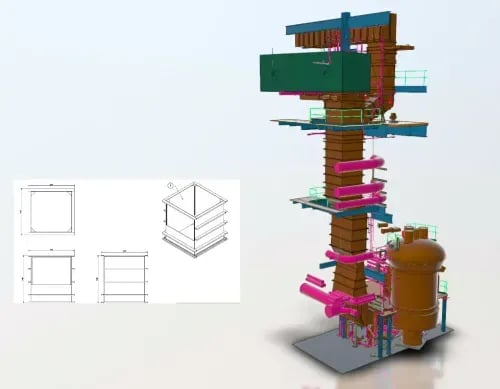
Extend the life of legacy equipment
Recreate and replace hard-to-source or unsupported components without relying on OEM documentation or discontinued suppliers.
Support accurate modifications and upgrades
Make informed design changes using precise digital models that reflect what actually exists—not what was assumed or documented years ago.
Start with accurate data you can trust
Talk with our team about your facility, scope, and objectives to determine the right capture, modeling, and analysis approach.