
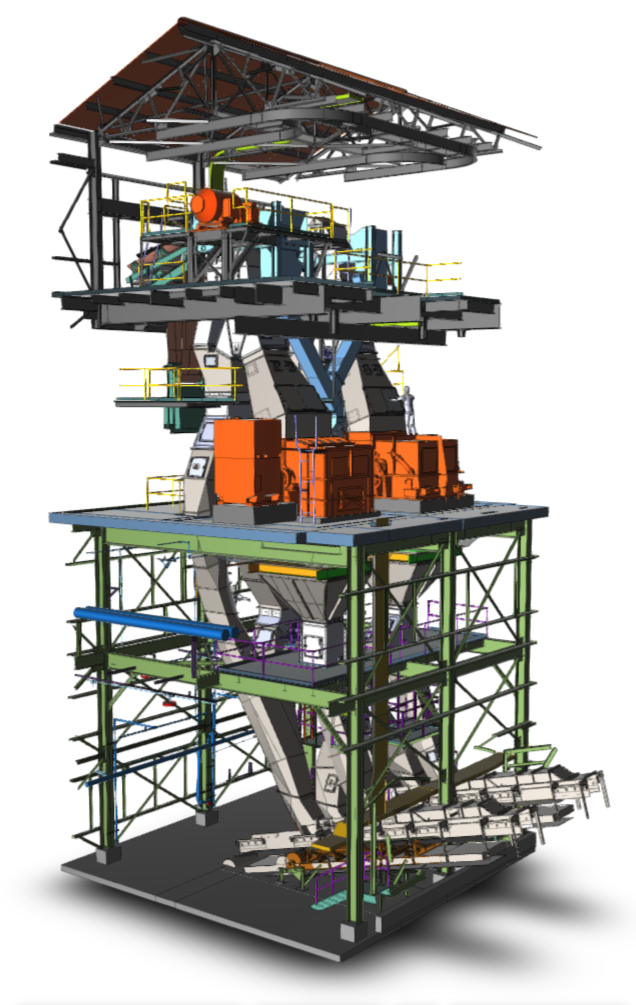
Somebody calls about scanning a grain elevator, a cement plant, a sugar refinery or a wood products facility, and three questions in, the conversation stops at the same place: can you even bring that equipment in here?
It is a fair question and it is almost never answered honestly. Most scanning vendors either have not thought about it or would rather not raise it. So here is the actual picture.
A combustible dust area is classified under the National Electrical Code as Class II. The division tells you how often the hazard is present.
Class II, Division 1 — combustible dust is in the air under normal operating conditions in quantities sufficient to produce explosive or ignitable mixtures. Or mechanical failure could produce that condition while simultaneously producing an ignition source.
Class II, Division 2 — combustible dust is not normally in suspension, and normal operations do not put it there, but accumulations exist and abnormal conditions could suspend them.
The distinction matters because equipment entering these spaces has to be rated for them. That is not a policy preference, it is how the electrical code works, and a plant's own procedures will generally enforce it harder than the code does.
Here is the part worth being direct about: most terrestrial laser scanners are not rated for Class II Division 1 or Division 2 service. They are precision instruments with motors, batteries, and heat-generating electronics. A handful of specialized intrinsically safe survey instruments exist. A standard scanner is not one of them, and any vendor who tells you their off-the-shelf scanner is fine to run in a Division 1 area should be asked to produce the rating documentation.
That does not mean the facility cannot be captured. It means the route in is a project decision rather than an equipment decision.
In 2025, NFPA published the first edition of NFPA 660, Standard for Combustible Dusts and Particulate Solids, consolidating five previously separate documents — NFPA 61 (agricultural and food processing), NFPA 484 (combustible metals), NFPA 652 (fundamentals), NFPA 654 (combustible particulate solids) and NFPA 655 (sulfur).
If you built a dust hazard analysis program against NFPA 652, the fundamental obligations did not disappear. What changed is the citation and the structure — one standard with a common chapter set and commodity-specific chapters rather than five documents with overlapping and occasionally conflicting requirements.
For documentation purposes the consolidation is a useful prompt, because a dust hazard analysis is performed against an equipment arrangement. It identifies where dust is generated, where it accumulates, where ignition sources sit relative to it, and what the consequences of a deflagration in that space would be. All of that reasoning rests on a description of the facility.
If that description is a drawing set that predates the last three modifications, the analysis is describing a plant that has moved on. Add a transfer point, reroute a duct, replace a collector with a different footprint, and the arrangement the DHA was built on is no longer the arrangement in the building.
That is the connection between documentation accuracy and dust compliance that almost nobody makes: the drawings are not a filing requirement, they are the substrate the analysis sits on.
A common assumption is that a hot work permit solves the problem. It does not, and the reason is worth understanding.
Hot work permitting is a control process for introducing an ignition source into an area where one is not normally present — welding, cutting, grinding. The permit exists to force a sequence: clear the area, remove or protect combustibles, test the atmosphere, post a fire watch, hold the watch after the work ends.
Running a scanner is not hot work in the conventional sense. But the permit framework is often the mechanism a plant will use to authorize any non-rated electrical equipment entering a classified space, because it is the process that already exists for "something is going in there that normally would not."
What that means in practice is that the permit does not make the equipment compliant. It documents a controlled deviation, usually with conditions attached — process down, area cleaned, atmosphere tested, duration limited, someone watching.
Those conditions shape the scan plan more than any technical setting does.
Route one: capture during the outage, with the process down.
This is the cleanest answer and it is why dust-handling facilities and scan scheduling are so tightly coupled. With the process down, the material cleared and the area washed or vacuumed, the classification basis changes and the permitting conversation becomes straightforward.
The trade-off is that you are competing for the same window as every other trade, on the tightest schedule of the year. Which is why the capture plan has to be built before the outage, not during it — you get the access you negotiated in advance, not the access you ask for on day three.
Route two: work the boundary and accept the coverage limit.
Many facilities are only classified in specific zones. The elevator leg, the enclosure around the transfer point, the interior of the collector. The surrounding structure often is not.
A scan from the unclassified side captures more than people expect — a scanner with 70 to 350 metre range and a clear line of sight will pick up a great deal of the structure surrounding a classified zone, and grated platforms let it see through floors from above. You will have occlusions and gaps where the classified envelope begins.
The honest version of this route is that you get a very good model of 80 percent of the area and an explicit, documented hole where the rest is. Sometimes that is entirely sufficient — if the work is structural steel modification around a bin rather than inside it, the inside of the bin was never the deliverable.
Route three: run the equipment assessment and permit process properly.
For a site that needs interior capture and cannot take an outage, this is the path. It is slower and it involves the plant's own safety organisation from the beginning rather than at mobilisation.
What it requires: equipment documentation showing what is actually being brought in, a written scope with duration and location, the plant's permit process applied with whatever conditions it imposes, and a crew that has been through the site-specific training. On MSHA-regulated sites this also means Part 46 or Part 48 contractor training, which is its own gating item and a common reason a vendor cannot mobilise at all.
Not "can you scan a dust area." Almost anyone will say yes.
Ask instead: which of those three routes are you proposing, what does your equipment documentation say, and what coverage am I actually getting under the route you picked?
A vendor who has done this work will answer in specifics — they will tell you where the gaps will be before they mobilise. A vendor who has not will tell you it will be fine.
The reason any of this matters is that dust-handling facilities are exactly the sites where existing conditions are least reliable. Containment gets retrofitted. Ductwork gets rerouted. Collectors get replaced with different models on the same footprint. These are incremental, legitimate, and almost never redrawn.
Then a dust hazard analysis, a containment retrofit, or an insurance review needs an accurate arrangement, and there is not one.
Capturing these facilities is harder than capturing a machine shop, and the constraints above are real. But the sites where it is hardest are also the sites where the documentation gap costs the most, which is an uncomfortable and fairly consistent rule in this work.
Related: 3D laser scanning · Accurate as-built P&IDs and why process plants need laser-scanned documentation
AsBuilt 3D captures existing conditions in operating industrial facilities — including classified and dust-handling environments where access, permitting and scheduling drive the plan as much as the technology does. Our crews carry a minimum of 80 hours of safety training and we rank in the top 1% of approximately 9,000 contractors on ISNetworld. If you have a dust-handling area that needs documenting, the first conversation is about access, not equipment.
Sources: NFPA 660 Standard Development · Consolidated Combustible Dust Standards Ready in 2025 — Powder & Bulk Solids · NFPA 660 Consolidates Regulations — Donaldson · What is NFPA 660? — BakerRisk

Each project represents our commitment to accuracy and technical excellence


Talk with our team about your facility, scope, and objectives to determine the right capture, modeling, and analysis approach.