Few ideas have gained more attention in industrial operations than the digital twin. Owners want one. Engineering teams are asked to build one. Software vendors promise that a single connected model will unlock predictive maintenance, faster retrofits, and safer shutdowns.
Yet many digital twin projects stall. The renders look impressive, but the model never becomes something operators, engineers, and contractors actually trust and use. The gap between a good-looking 3D scene and a working digital twin almost always comes down to one thing: the accuracy of the existing conditions underneath it.
A digital twin built on assumptions is just a 3D picture. A digital twin built on field-verified reality capture becomes a decision-making tool. For brownfield industrial facilities, where drawings are often outdated or missing, that distinction is everything.
This guide explains what a digital twin actually is, how it differs from BIM, how to build one from a point cloud, how much detail you really need, and why so many programs fail before they deliver value.
A digital twin is a virtual representation of a physical asset that is kept aligned with the real thing over time. For a facility, that asset might be a single piece of equipment, a process area, or an entire plant. The twin combines accurate geometry with data, so teams can plan, analyze, and make decisions against a reliable digital version of what exists in the field.
It helps to think of the digital twin as a spectrum rather than a single product. On one end is a static, geometrically accurate model of existing conditions. On the other is a live twin connected to sensors, maintenance systems, and operational data. Most industrial facilities do not start with a fully connected, real-time twin, and they should not. They start with an accurate as-built foundation and layer capability on top of it as the business case grows.
That foundation is where the twin either succeeds or fails. If the geometry is wrong, everything built on top of it inherits the error.
These three terms are often used interchangeably, which creates confusion. They are related, but they are not the same.
A 3D model is geometry. It shows shape, size, and spatial relationships, but the objects may carry little or no information beyond their form.
BIM, or Building Information Modeling, adds intelligence to that geometry. Objects become data-rich elements: a pump is a pump, with attributes, specifications, and relationships to other systems. BIM supports coordination, clash detection, and information handoff.
A digital twin goes one step further. It connects that intelligent model to the real asset and its lifecycle, and it is maintained so it stays current as the facility changes. In practice, a strong industrial digital twin usually starts as an accurate as-built BIM model and evolves as operational data is connected to it.
The key point: a digital twin is not a file you buy once. It is a living representation you build on a verified baseline and keep alive.
On a greenfield project, you can generate a twin directly from design intent because the building does not exist yet. Industrial reality is rarely that clean. Most plants have decades of modifications, undocumented changes, and drawings that no longer match the field.
In that environment, the twin cannot be based on what the paperwork says should exist. It has to be based on what is actually there. A valve that was relocated during a past outage, a pipe run that was rerouted, a platform that was added for access, all of it has to be captured accurately or the twin will quietly mislead every team that relies on it.
This is why reality capture is the right starting point for an industrial digital twin. Laser scanning records the facility as it exists today, down to the millimeter, without depending on legacy documentation. It is the same principle behind verifying fit before an outage window: you cannot plan reliably against conditions you have only assumed.
Related reading: Everything You Need to Know About BIM Coordination
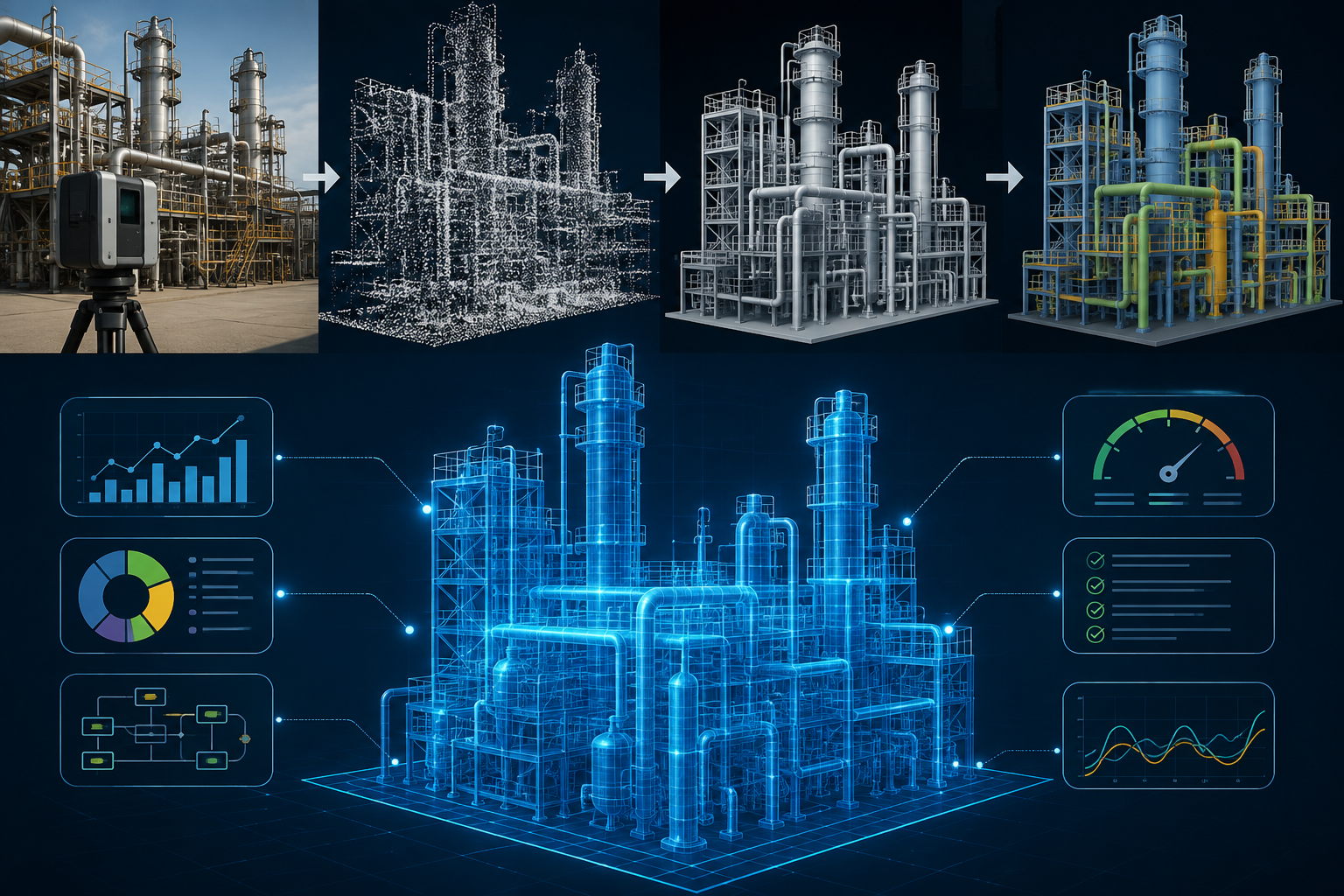
Building an accurate industrial digital twin is a disciplined process, not a single software step. The workflow below reflects how AsBuilt approaches it, from first scan to a maintained model.
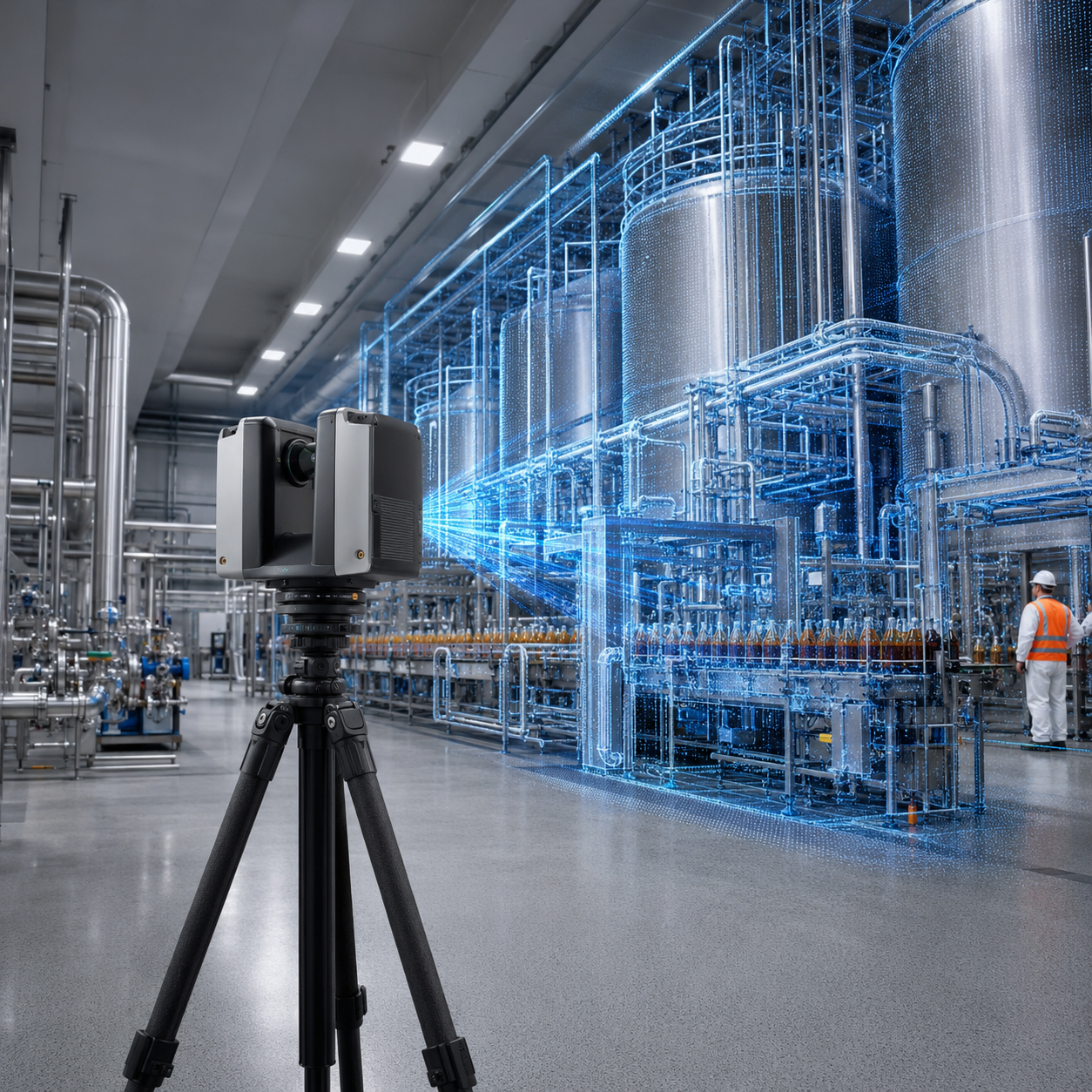
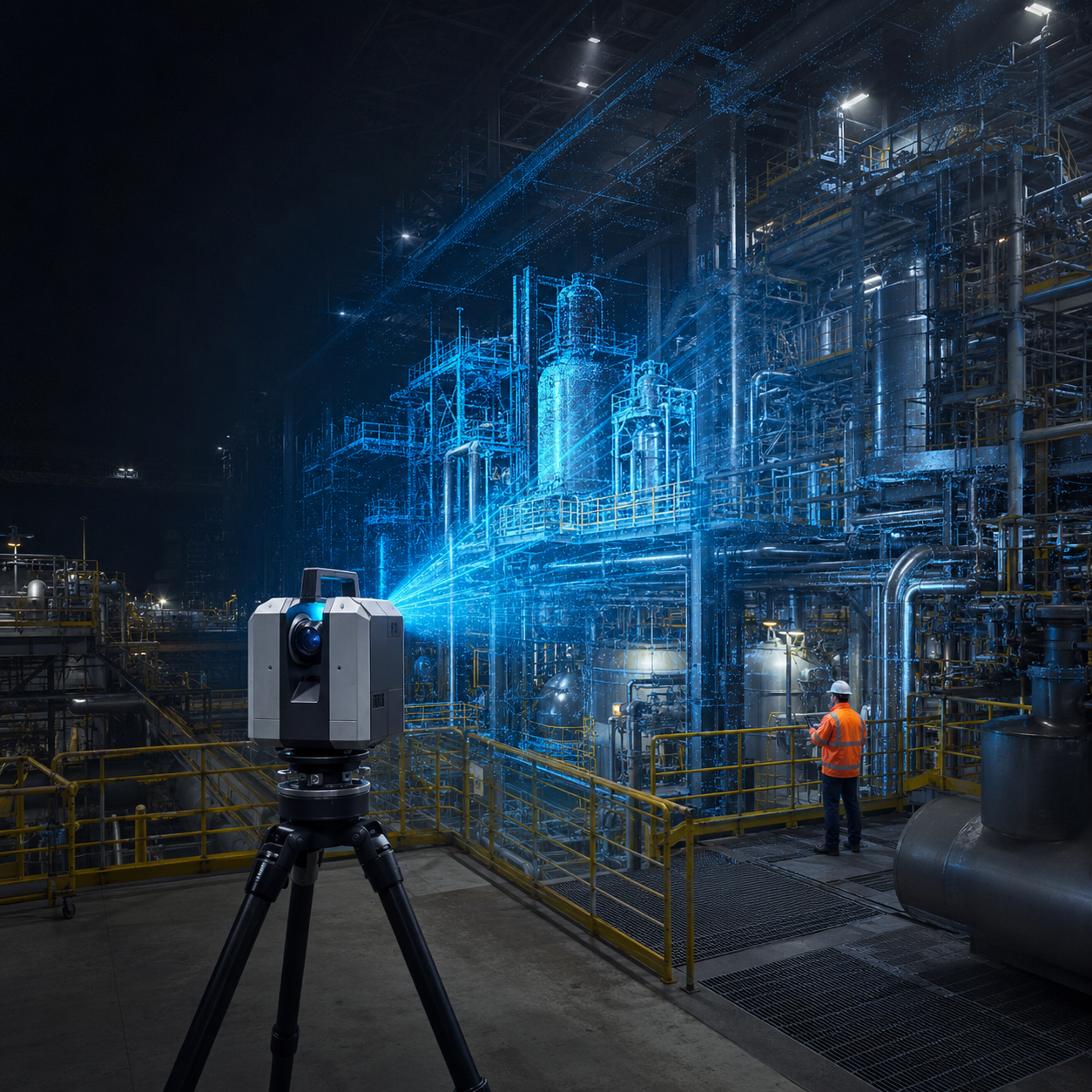
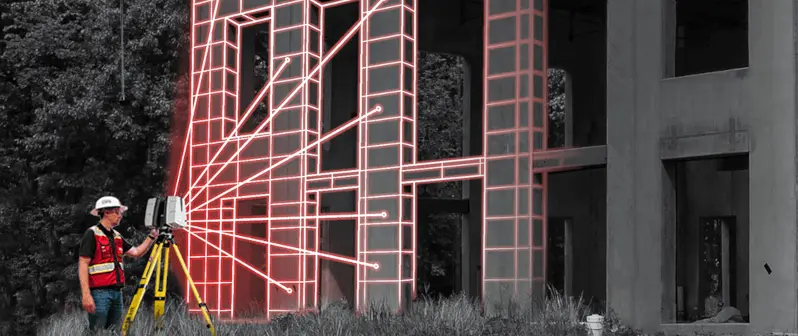
The process begins with 3D laser scanning. High-accuracy scanners capture millions of measured points across the facility, producing a dense point cloud that records equipment, structure, piping, and clearances exactly as they are. Good capture planning matters here: scan positions, resolution, and control all affect how usable the data will be downstream. This can typically be done in active facilities with minimal disruption to operations.
Individual scans are then registered into a single, coordinated point cloud tied to a real-world coordinate system. This step aligns every scan position so the dataset is spatially accurate and consistent. Clean registration is what turns raw scans into verifiable existing-conditions data that engineering and construction teams can measure against with confidence.
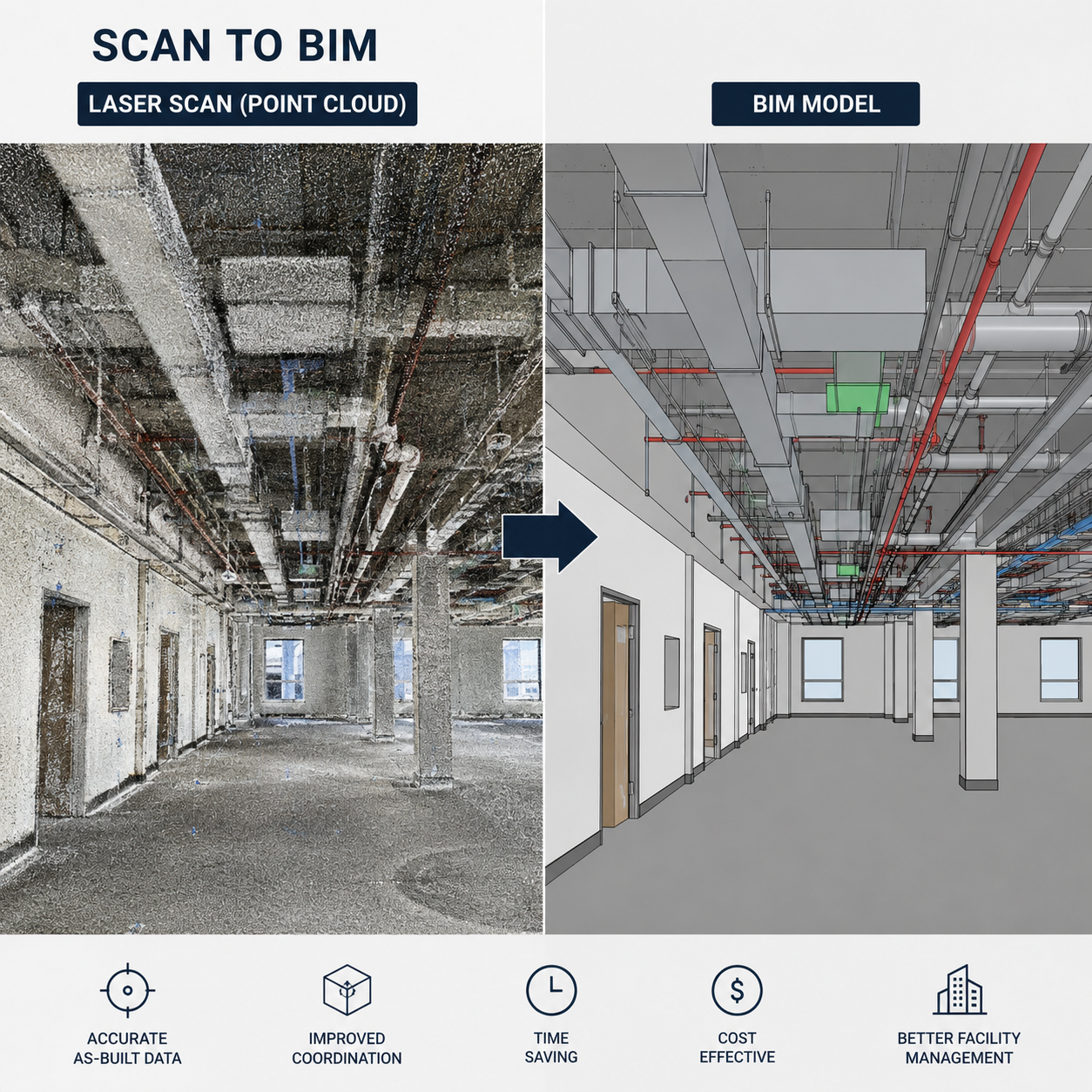
A point cloud is accurate, but it is not yet a twin. The next step is scan-to-BIM: converting the point cloud into an intelligent 3D as-built model where components are modeled as real objects rather than points. Depending on the use case, teams may also produce 2D as-built drawings from the same dataset. This modeled foundation is the geometric core of the digital twin.
Geometry alone is a 3D model. A twin becomes valuable when the objects carry information: equipment tags, specifications, materials, maintenance history, or links to asset management systems. How much data you add depends entirely on what the twin is for, which is why defining the use case before modeling saves significant cost.
The enriched model is then made accessible to the teams who need it, whether that means a hosted point cloud and model, integration with existing engineering platforms, or connection to operational data for a more advanced twin. The goal is a single source of truth that owners, engineers, and contractors can all work from.
A digital twin that is never updated slowly becomes another outdated drawing set. As the facility changes, the twin must change with it. Tying updates to your management of change process keeps the model trustworthy over its full lifecycle.
One of the most expensive mistakes in digital twin work is modeling everything to the highest possible detail by default. More detail is not automatically more value. It is more cost, more time, and more to maintain.
The right level of detail is driven by the use case. A twin used for high-level capital planning and space validation does not need the same fidelity as one used for prefabrication and tight clash detection. Reality capture accuracy, model level of detail, and the amount of embedded data should each be scoped to the decisions the twin needs to support.
The disciplined approach is to define the questions the twin must answer first, then capture and model to meet those questions, with room to extend later. This keeps the investment aligned with real operational value.
When it is built on an accurate foundation, an industrial digital twin supports work across the entire facility lifecycle:
Most digital twin disappointments are not caused by the wrong software. They come from a handful of avoidable mistakes.
The first is an inaccurate baseline. When the twin is built on outdated drawings or incomplete capture, every downstream decision inherits that error, and trust erodes quickly.
The second is over-scoping. Trying to model an entire plant to maximum detail before proving value leads to stalled, over-budget efforts. The third is treating the twin as a one-time deliverable rather than a maintained asset, so it drifts out of date. And the fourth is disconnecting the twin from real workflows, leaving an impressive model that no one uses because it is not tied to how teams actually make decisions.
Every one of these traces back to the same discipline: start with accurate existing conditions, scope to the use case, and plan to keep the model current.
A digital twin is only as good as the reality it is built on. For industrial facilities, that means starting with accurate, field-verified existing conditions and building deliberately from there, rather than starting with software and hoping the data catches up.
AsBuilt helps owners, engineers, and contractors build that foundation, from 3D laser scanning and point cloud processing through as-built modeling, verification, and coordination. The result is a digital representation you can actually plan, design, and execute against.
If you are considering a digital twin for your facility, we can help you scope it to the outcomes that matter. Request a quote or schedule a call to talk through your project.

Each project represents our commitment to accuracy and technical excellence

Talk with our team about your facility, scope, and objectives to determine the right capture, modeling, and analysis approach.